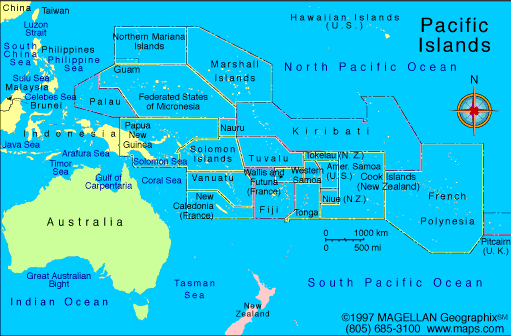
Lytton Advisory is pleased to advise that in December 2022 Craig Lawrence was appointed as a consultant to the Pacific Regional Infrastructure Facility (https://www.theprif.org/what-we-do).
He will be assisting PRIF by helping Pacific Island states develop national infrastructure investment plans to drive economic and social development.
Craig is Managing Director of Lytton Advisory. For the past nine years he has led teams of economists examining infrastructure and public policy issues.
Like many folk over the summer holiday, I played around with ChatGPT, a natural language AI.
Being an economist, I asked for the meaning of Opportunity Cost, a foundation concept in economics. The response was deadly boring.
So I asked it to flick a switch and give it as a sonnet:
Opportunity cost, a term so fine, Refers to the cost of choice not made, The next best option left behind, When one decision is the one laid.
It’s something we encounter every day, From big choices to the small and meek, But often we don’t stop and weigh The cost of what we choose to seek.
So think before you act, consider well, The path you take and what it means to stray, For opportunity cost will dwell In every choice you make, come what may.
So choose with care and wisely weigh, The cost of all the options in play.
ChatGPT
This might be all a bit too much for those in the C Suites, so here is your executive haiku:
Pacific Island nations have complex requirements for infrastructure. It is tempting but foolish to see similarities and simply apply a one-size-fits-all.
However, the best combination of infrastructure assets for Pacific Island nations will depend on the specific needs and resources of each individual nation. In general, however, there are a few key types of infrastructure that are important for the development and well-being of Pacific Island nations.
Transportation infrastructure: This includes roads, ports, airports, and other transportation networks that are necessary for the movement of people, goods, and services within the country and to other countries.
Energy infrastructure: This includes power plants, transmission and distribution networks, and other facilities that are necessary for the generation and distribution of electricity.
Telecommunications infrastructure: This includes networks of communication towers, cables, and other equipment that are necessary for providing telephone and internet services to the population.
Water and sanitation infrastructure: This includes systems for the treatment, distribution, and collection of water, as well as sewage treatment facilities and other infrastructure related to sanitation.
Health care infrastructure: This includes hospitals, clinics, and other facilities that are necessary for providing health care services to the population.
Educational infrastructure: This includes schools, universities, and other institutions that are necessary for providing education to the population.
It is important for Pacific Island nations to have a balanced and well-developed infrastructure system in order to support economic growth, improve living standards, and enhance the overall well-being of the population. It means having an approach that enables strategic consideration and appraisal of a diverse combination of assets across a diverse set of countries.
Recently, the Federal Government decided that it does not want to interfere in the market for the private provision of rapid antigen tests in the middle of a pandemic.
Preserving the right of private businesses to profit during the pandemic at the potential expense of the vulnerable is simply not a great policy.
What are the economics behind this, and what might they be missing?
Rather than assume it is simply a cop-out, it seems it is a naive application of Economics 101. However, the policy is not well thought through.
The implicit assumption is that there are no significant positive externalities in subsidising the cost of rapid antigen tests. That is the information benefits of knowing whether you have Covid and taking personal responsibility by appropriately isolating to avoid infecting other people are neither insignificant nor irrelevant.
The US National Bureau of Economic Research recently concluded that much of the decline in economic activity in the US associated with Covid-19 came from self-protective behaviour. As Australia re-opens its economy, this is likely to become a potential handbrake when uncertainty about managing the virus is widespread in the community. RATs provide a frontline but partial solution to this self-protective behaviour.
Research by the Royal Australian College of General Practitioners suggests there is a case for substituting PCR tests with RATs, and saving public funds. The benefit comes from earlier knowledge of infection and people isolating earlier, lessening the spread of the virus.
The government’s approach presupposes that rapid antigen tests are a consumer item rather than a public health consumable. A bit like asking people to bring their own oxygen bottles to hospital. Now that is something we have seen elsewhere.
The Australian Chamber of Commerce and Industry recognises the information value of RAT, advocating free rapid testing will improve business and consumer confidence, assisting in reopening the economy after a series of lockdowns and international lock outs. This will help minimise the extremely disruptive impact of snap closures and held businesses reduce risks to employees, customers and the community.
The government has argued that it does not want to provide ‘free’ rapid antigen tests. However, that is misleading. Publicly provided tests are paid out of taxation revenues. Either way, we are paying for these tests.
I find it difficult to believe that the Commonwealth cannot secure bulk supplies of these tests and distribute them at less cost than I could purchase one at full retail prices.
Also, it is surprising to me that given the extensive use of rapid antigen tests elsewhere, the Federal Government has not provided more effective leadership on this.
The Australian Competition and Consumer Commission is awake to the risk of price gouging and has indicated it will ‘name and shame’ those that do.
With Covid case numbers soaring again, the test and trace systems are simply not up to the task given volumes. Rapid antigen tests provide a viable alternative to enable people to be informed about their own health status and act accordingly. That has to benefit their families, friends and co-workers and, ultimately, the wider society and economy.
I was thinking that we were all in this together. The Federal Government still needs to catch up. We can’t afford another strollout in a fast-moving medical environment. Time and again, we have seen political processes simply cannot match the pace of this pandemic.
Let’s not think Covid has passed just yet. People are still dying.
Thanks to my colleague and good friend, Gene Tunny, for recently inviting me onto his Economics Explored podcast to talk about the circular economy. Listen to the podcast here:
As we increasingly incorporate a lot of the environmental externalities into the incentive architecture of the market economy, opportunities to improve our stewardship of finite natural resources will improve. Not only do we have to do things better, the approach underlying the circular economy encourages us to do better things.
Mid afternoon snap of LA traffic. Usually at this time of day it would be bumper-to-bumper. The Governor of California has ordered the State’s 40 million citizens to stay home, restricting non-essential movements. Source: The Mercury News, CA.
The coronavirus pandemic will have significant impacts on how we design, develop, fund and operate infrastructure. As the pandemic evolves, the nature of these impacts will emerge, creating increasing risks. There is a stark difference between the impact of the Global Financial Crisis (GFC) and this pandemic. The former was initially a financial liquidity impact that affected cash flows around infrastructure investment and operation.
The pandemic’s first impacts are likely to be around the loss of human capacity in the systems that support this complex sector. The near term impacts are likely to be more associated with loss of certainty, affecting planning, operation and funding of infrastructure.
There is a range of considerations; which will have varying degrees of impact on governments, communities, organisations and people.
i) Demand-based assets are vulnerable because of the drop in use as with the coronavirus takes away discretionary spending. This particularly so for transport infrastructure, which directly engages with end consumers. Supply chains for these assets will be affected.
ii) Contracted assets have some increasing counterparty risk. Energy assets, for example, depend on the continuing creditworthiness of their counterparties. Many utility services may be called on by state actors to contribute to the overall effort to address the economic impacts of coronavirus.
iii) Merchant infrastructure potentially faces higher volatility in commodity prices and heightened uncertainty of demand. This kind of infrastructure operates at the margin of markets, rather than profiting from significant baseload provision at low, guaranteed margins. It will vary across markets for infrastructure services.
iv) Some specialised infrastructure has exposure to sports. This group of assets has both contracted and demand-based revenues. In Australia, we see the challenges facing our principal football codes with the loss of stadium revenues. It has exposed football codes that have not been developing multi-year contracts for stadiums and areas, and cannot defer refunds and provide credits for future ticket purchases. Some infrastructure owners have not undertaken sufficient risk analysis to determine the financial reserves for significant events.
v) Expect construction delays and cost increases as labour and material shortages occur, as well as the introduction of appropriate occupational health and safety processes are developed to address coronavirus.
vi) Expect the possibility of some operating underperformance of infrastructure assets associated with possible labour and material shortages. As operating environments are adjusted, with some delays in scheduled maintenance, this should only be a short-term impact. Retaining the capacity to do critical maintenance is essential.
vii) Contractual triggering of force majeure declarations may become more likely. The effectiveness of these declarations will depend on the specific wording in each contract, which may create many disputes around non-performance.
viii) Policy exclusions in business interruption insurance may affect the ability of infrastructure asset owners and operators to respond. Management teams are going to have to think more about internal liquidity policies and how to structure their cash flows in both infrastructure transactions and operations.
ix) The debt position infrastructure owners and operators will be compounded by refinancing challenges. More volatile credit markets mean more considerable uncertainty about the costs of refinancing when it is needed. Understanding debt maturation profiles and alternatives will be essential. Assets with long concession periods or very long useful lives possibly have a better ability to manage their short term debt profiles.
Some of these risks might be mitigated in part by the following:
i) Government intervention is more likely to occur. While some government actions might have adverse impacts. Across a range of infrastructure classes, governments might take interaction to support the overall performance of the economy.
ii) Infrastructure businesses are more protected at the enterprise level. Many firms operate in multiple markets and hold multiple sets of infrastructure assets. Also, many infrastructure businesses operate long-live assets with capex plans that can be modified and significant management discretion on operational tempo and allocation of surpluses.
iii) Infrastructure projects typically have strong capital structures. How cash flows are applied is tied to contractual requirements and ensuring funds flow to relevant parties. This is the core of traditional project financing. Infrastructure projects without recourse to full cash-funded debt reserves are exposed to prolonged delays and a slow economic recovery.
Our response to coronavirus is only limited by our understanding of it and our ability to imagine and execute solutions.
Constrained water supplies in Far North Queensland are hindering economic development and can threaten water security of a number of towns. Inaction on supply has been driven by feasibility, concerns, funding gaps and worries about environmental sustainability. (1) In addition, politics focussing narrowly on dams as the supply solution runs the risk of missing other smart infrastructure and demand management opportunities to improve supply apart from just bulk storage. (2) Project proponents are also challenged often challenged by a user pay model required by the National Water Initiative. (3)
A strong evidence base of economically viable, financially feasible and prudently sustainable investments is needed to unlock these constraints. The balance between the public purse, private irrigator interests and environmental sustainability needs to be reset.
If considering just dams, what is an appropriate period of cost recovery? If an appraisal period is less than the economic life of the dam, usually an estimate of residual value would be included in the final year of the analysis. For example, a 25-year appraisal period for a 50-year asset, may include an asset value offset of up to 50% in the final appraisal year to ensure cost recovery over the appraisal period approximates around half of the expected use of the asset.
Similarly, where a dam is considered by policy makers to be a catalytic piece of infrastructure that supports and enables economic growth opportunities, an argument that there are economic externalities needs to be established. In effect, this means that not all the economic benefits are being captured by the users – providing a basis for partial public funding alongside expected user revenues. This externality argument is the logical basis for identifying the level of offset to user revenues. It presupposes both other uses for water as well as downstream benefits captured by non-users.
As a starting point, getting the evidence together to make the preliminary case for the residual value argument and a market failure argument around significant externalities is critical.
There is a handy infographic on Council’s website. Unfortunately, details of how the benefits have been calculated are not publicly available.
What we do know is that Council intends to spend $190 million to build the bridge. Council believes trips per day will rise from 5,300 in 2021 to 6,100 in 2036.
Making a couple of assumptions, we can work out the level of benefit per trip required for this to cover the capital costs. First we assume a 25 year evaluation period (2020-2044) and a 7% real discount rate. We also assume the asset has a 50 year life and include an offset residual value on the capital cost. The capital cost attributable to the evaluation period is a present value of $172.5 million.
Then we extrapolate the average crossings, which rise on an annualised basis from 1.9 million trips in 2021 to 2.4 million trips in 2044. This implies some 54 million trips will take place (2021-2044). However, using trips as a stand in for benefits, a trip today has a stronger present value than a trip tomorrow. The present value of all the trips had they occurred today is 24.5 million.
The capital cost per trip is $3.18 undercounted. In discounted terms, this is $7.03.
Given ratepayers are paying for it, one would hope Council is confident benefits are at least $7.03 per trip in benefits.
L-R: Nick Behrens, Craig Lawrence, Gene Tunny, Hamish Bain.
Intra regional trade and the effectiveness of 147 active zones (economic, industrial and free) in the Middle East will be under consideration by Lytton Advisory. The firm has been given a mandate to develop advice for the Gulf Cooperative Council Secretariat on the next phase of closer economic cooperation between member states. This will involve a baseline review of existing economic zones, careful analysis of customs arrangements between Gulf states, an examination of World Trade Organisation implications and economic modelling of preferred solutions. Lytton Advisory is looking forward to working with colleagues from Maxwell Stamp in the Middle East, building on engagements in the region over the past three years.
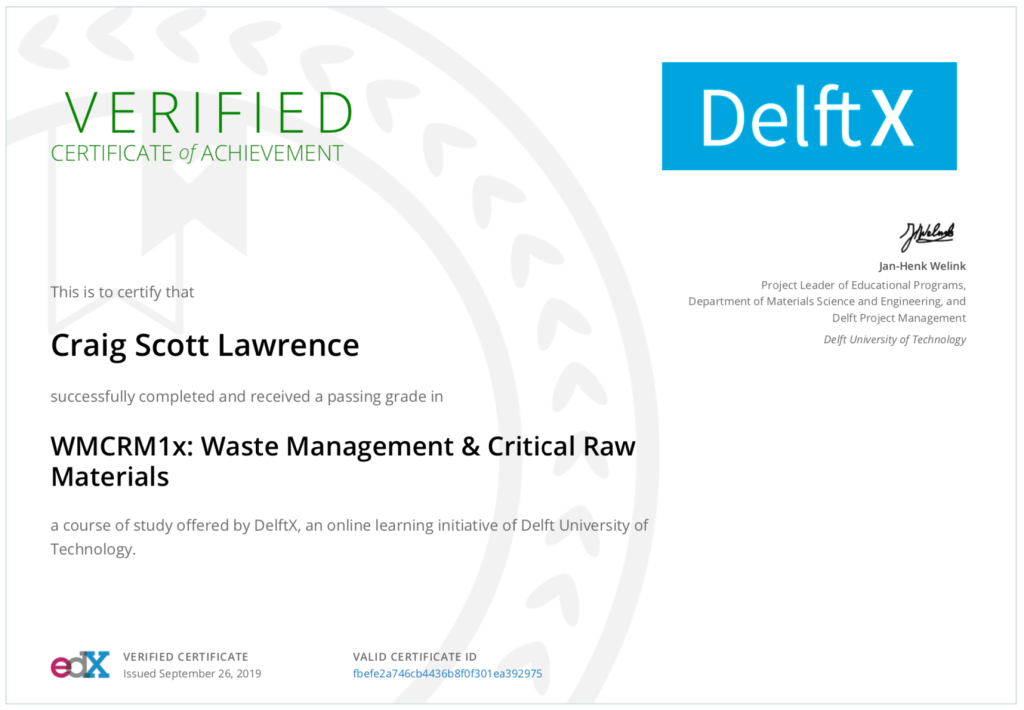
Linear economic systems are inherently unsustainable, creating intergenerational equity where markets for this are not readily available. Understanding waste management approaches and the role of critical raw materials is key to developing effective approaches that move us towards the circular economy. It was one of the reasons I recently completed a short course in these issues.





 Lytton Advisory