As Queensland’s local governments strive to ensure sustainability in waste management, innovative techniques like A-B Testing are increasingly gaining traction. This method, commonly used in marketing to test consumer preferences, can also be applied to household waste behaviour. It involves comparing two groups – one following the current waste management practice (A) and the other testing a new approach (B).
Recently I have been thinking about three ways this might be done in a local government context:
Study 1: Recycling Education Programs. Educational programs about the importance and methods of recycling are key to promoting responsible waste management. A-B Testing can be used to measure their effectiveness. Group A could continue with the current education approach, while Group B would receive enhanced education material – perhaps more engaging, interactive content. The success could be measured in terms of recycling rates, contamination rates, and waste volume reduction.
Study 2: Waste Collection Frequency. Changing the frequency of waste collection is another variable local governments could experiment with. Group A could maintain the current schedule, while Group B could have more frequent recycling pickups and less frequent general waste pickups. This encourages households to recycle more and could result in substantial landfill reduction.
Study 3: Pay-As-You-Throw (PAYT) Policies. Finally, implementing PAYT policies could be a game-changer. Under this scheme, households are charged based on the amount of waste they produce. Group A could continue with the flat fee structure, while Group B would test the PAYT policy. The impact would be measured through waste volume, disposal costs, and recycling rates.
A-B Testing in these areas could provide local governments with robust data on the effectiveness of new waste management strategies. It’s an evidence-based approach that can drive better policy-making and offer several potential gains. There are many more options for this kind of analysis.
But what are the benefits?
For the councils, the benefits include better resource allocation, improved recycling rates, and reduced costs associated with waste management. It can also drive innovation in service delivery and contribute to sustainability goals.
Ratepayers also stand to gain significantly. Efficient waste management systems can lead to lower rates over time. Moreover, they provide an opportunity for households to play an active role in waste reduction and recycling, contributing to the larger goal of environmental sustainability.
A-B Testing allows us to bring data to the heart of decision-making, fostering an innovative, evidence-based approach to household waste management. Queensland local governments, by embracing such methodologies, can set an example in driving sustainability through informed, data-driven decisions.
All too often it is too easy to simply offer financial incentives to encourage greater recycling to households. Municipal waste management often considers that education of households can lead to improvements in recycling outcomes. While this is intuitively appealing, there is often little genuine analysis.
Behavioural economics offers an approach driven by empirical analysis and fieldwork, rather than theory or ‘gut feel’, to develop tailored approaches to achieve better recycling outcomes. Large numbers of household units offer the opportunity to experiment with the recycling incentive architecture before a full roll out across a municipal area.
Behavioral economics is important in recycling because it can help understand why people do or don’t recycle, and how to design policies and programs that encourage more recycling. Here are a few specific reasons why behavioral economics is important in recycling:
People’s behavior is influenced by more than just economic incentives. Traditional economics assumes that people make decisions based on rational self-interest, but behavioral economics recognizes that people’s decisions are also influenced by factors such as social norms, emotions, and cognitive biases. By understanding these other factors, behavioral economics can help design policies and programs that are more effective in encouraging recycling.
People’s behavior is influenced by the design of the recycling system. The way recycling is presented to people, such as the location of recycling bins and the clarity of recycling instructions, can have a big impact on whether or not people recycle. Behavioral economics can help identify ways to make recycling more convenient and understandable, increasing the likelihood that people will recycle.
People’s behavior is influenced by their perception of the benefits and costs of recycling. Behavioral economics can help identify ways to communicate the benefits of recycling more effectively, such as highlighting the environmental and economic benefits of recycling, and can help identify ways to increase the perceived costs of not recycling, such as highlighting the environmental damage caused by waste.
People’s behavior is influenced by the way decisions are framed. Behavioral economics can help identify how to frame decisions in ways that encourage more recycling, such as by highlighting the social norm of recycling or using loss aversion to encourage recycling.
Overall, behavioral economics can help design more effective policies and programs that encourage more recycling by understanding the factors that influence people’s behavior, and by designing the recycling system in ways that take these factors into account.
To what extent are the incentives in your organisation grounded in analysis, recognise bias factors, presented to encourage action, framed to encourage positive decision making by households?
Following the NSW Government’s released of an independent review of its resource recovery framework and implications for the circular economy, three key takeaways struck me:
The review identified friction between the environment and safety objectives of the existing NSW waste and resource recovery framework and the need for flexibility to support innovation and a smooth transition to a circular economy.
A key criticism of the EPA was their handling of the revocation of the mixed waste organic material (MWOO) exemption in 2018. This led to recommendations for the resource recovery regime to be put on a similar footing to environmental and planning approval regimes.
The debate over the definition of waste continues, as the broad interpretation in the case of EPA v Grafil has potentially slowed the advancement of the circular economy.
The Review made a recommendation that the EPA should investigate a pathway to enable an “end-of-waste” outcome for suitable common, low-risk recovered materials to better enable reuse and promote circularity.
There were many other matters raised in the review, highlighting the challenges of both resource recovery and closing the loop between waste and input to future production processes.
The balance between environmental protection, regulation to achieve that and innovation to drive the emergence of the circular economy is still being worked out.
How do you think this is being played out in other jurisdictions? What tradeoffs have to be made between effective environmental regulation and commercial innovation to achieve the circular economy?
Thanks to my colleague and good friend, Gene Tunny, for recently inviting me onto his Economics Explored podcast to talk about the circular economy. Listen to the podcast here:
As we increasingly incorporate a lot of the environmental externalities into the incentive architecture of the market economy, opportunities to improve our stewardship of finite natural resources will improve. Not only do we have to do things better, the approach underlying the circular economy encourages us to do better things.
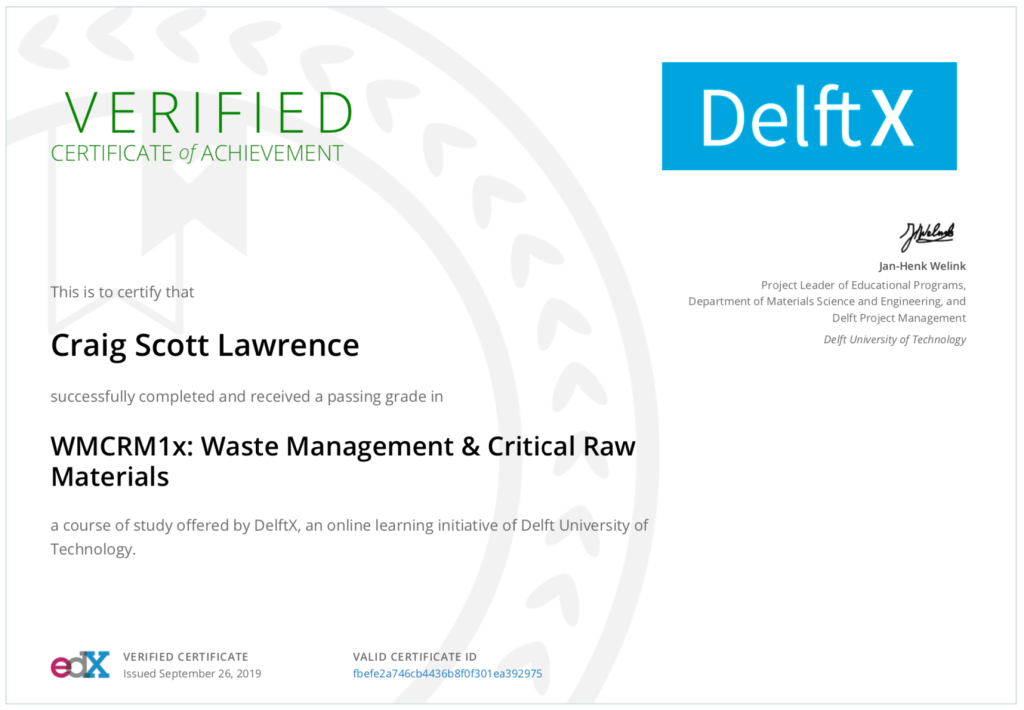
Linear economic systems are inherently unsustainable, creating intergenerational equity where markets for this are not readily available. Understanding waste management approaches and the role of critical raw materials is key to developing effective approaches that move us towards the circular economy. It was one of the reasons I recently completed a short course in these issues.



 Lytton Advisory