Categories
Economics Infrastructure Lytton Advisory

What are the infrastructure priorities in the Pacific?

Infrastructure: Definition, Meaning, and Examples

A significant challenge in developing infrastructure plans is prioritising the pattern of infrastructure investment.  In the Pacific, the infrastructure priorities of island nations are likely to vary depending on the specific needs and resources of each individual country. However, there are some common priorities that may be considered.

Transportation: Many Pacific Island nations rely on air and sea transportation for the movement of goods and people. Improving and expanding transportation infrastructure, such as airports, ports, and roads, can help facilitate economic development and improve connectivity within and between islands.

Energy: Many Pacific Island nations rely heavily on fossil fuels for energy, which can be expensive and environmentally harmful. Prioritising the development of renewable energy sources, such as solar and wind power, can help reduce reliance on fossil fuels and improve energy security.

Water and sanitation: Access to clean water and proper sanitation facilities is essential for public health. Improving water and sanitation infrastructure can help reduce the incidence of waterborne diseases and improve overall health outcomes.

Communications: Improving telecommunications infrastructure, such as internet connectivity and mobile phone networks, can help connect remote communities and facilitate economic development.

Healthcare: Access to healthcare is often limited in Pacific Island nations due to limited infrastructure and resources. Improving healthcare infrastructure, such as hospitals and clinics, can help ensure that people have access to essential healthcare services.

In addition to sectoral-focussed opportunities, there may also be individual, specific large scale projects that are part of a broader pattern of planned national development.  

Context is King in formulating priorities, but it does require an underlying framework of agreed infrastructure classification as well as a set of priority values which potential projects can be examined.
Categories
Economics Infrastructure Lytton Advisory

Good Infrastructure in the Pacific

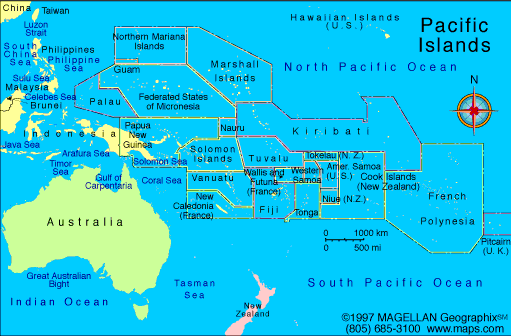
Map of Pacific Islands and Australia

Pacific Island nations have complex requirements for infrastructure.  It is tempting but foolish to see similarities and simply apply a one-size-fits-all.  

However, the best combination of infrastructure assets for Pacific Island nations will depend on the specific needs and resources of each individual nation. In general, however, there are a few key types of infrastructure that are important for the development and well-being of Pacific Island nations.

Transportation infrastructure: This includes roads, ports, airports, and other transportation networks that are necessary for the movement of people, goods, and services within the country and to other countries.

Energy infrastructure: This includes power plants, transmission and distribution networks, and other facilities that are necessary for the generation and distribution of electricity.

Telecommunications infrastructure: This includes networks of communication towers, cables, and other equipment that are necessary for providing telephone and internet services to the population.

Water and sanitation infrastructure: This includes systems for the treatment, distribution, and collection of water, as well as sewage treatment facilities and other infrastructure related to sanitation.

Health care infrastructure: This includes hospitals, clinics, and other facilities that are necessary for providing health care services to the population.

Educational infrastructure: This includes schools, universities, and other institutions that are necessary for providing education to the population.

It is important for Pacific Island nations to have a balanced and well-developed infrastructure system in order to support economic growth, improve living standards, and enhance the overall well-being of the population.  It means having an approach that enables strategic consideration and appraisal of a diverse combination of assets across a diverse set of countries.