
Categories
Climate Change Cost Benefit Analysis development Economics Infrastructure

Infrastructure Planning in the Pacific

Infrastructure investment planning in the context of Pacific Island nations requires a tailored approach that takes into account the unique characteristics and challenges of these countries. This is because Pacific Island nations have small populations, are geographically dispersed, and have limited resources. Therefore, infrastructure planning must be done in a manner that reflects their unique needs and priorities.

One of the best techniques for infrastructure investment planning in the context of Pacific Island nations is conducting a comprehensive needs assessment. This involves engaging with local communities and stakeholders to better understand their needs and priorities. This process is critical for identifying infrastructure gaps and prioritizing investment projects. Lytton Advisory considers this is best done at agency or infrastructure sector level.

Another important technique for infrastructure investment planning is taking a multi-sectoral approach. Infrastructure planning must take into account the interdependence of different sectors such as transportation, energy, water and sanitation, and telecommunications. A holistic approach is essential to ensure that infrastructure investments are aligned with the overall development goals of the country. In our view it also help more effective conversations with donors and private investors, helping countries retain greater sovereignty over national priorities.

Climate resilience is also a critical consideration in infrastructure investment planning in Pacific Island nations. These countries are particularly vulnerable to the impacts of climate change, and any infrastructure investment planning must take this into account. Projects should be designed to withstand extreme weather events and rising sea levels. Risk identification and mitigation are critical factors here.

Engaging the private sector can help to leverage additional resources and expertise for infrastructure development. Public-private partnerships can be a viable option for financing and delivering infrastructure projects. Private sector engagement can also help to promote innovation and efficiency in infrastructure development. However, the ability to engage the private sector also depends on national government capacity to see the commercial interests and incentives with great clarity.

Capacity building is critical to ensure that Pacific Island nations have the skills and expertise necessary to plan and implement infrastructure projects. This includes training in project management, procurement, and technical skills. By investing in capacity building, Pacific Island nations can become more self-reliant in planning and implementing infrastructure projects.

Sustainable financing mechanisms, such as green bonds and climate funds, can be used to finance infrastructure projects that have positive environmental and social impacts. This is important for ensuring that infrastructure investments are aligned with the overall sustainable development goals of Pacific Island nations. This also means identifying and avoiding some predatory financing practices as well, particularly where there might impose difficult burdens on the national treasury.

Finally, it is important to monitor and evaluate infrastructure projects to ensure that they are delivering the intended benefits and to identify areas for improvement. This includes tracking project performance against key indicators and engaging with stakeholders to gather feedback. By monitoring and evaluating infrastructure projects, Pacific Island nations can continuously improve their infrastructure planning and delivery processes. This is one of the hardest things to do, but has the potential to delivery greater informational value for future projects.

Categories
Economics Infrastructure Lytton Advisory

What are the infrastructure priorities in the Pacific?

Infrastructure: Definition, Meaning, and Examples

A significant challenge in developing infrastructure plans is prioritising the pattern of infrastructure investment.  In the Pacific, the infrastructure priorities of island nations are likely to vary depending on the specific needs and resources of each individual country. However, there are some common priorities that may be considered.

Transportation: Many Pacific Island nations rely on air and sea transportation for the movement of goods and people. Improving and expanding transportation infrastructure, such as airports, ports, and roads, can help facilitate economic development and improve connectivity within and between islands.

Energy: Many Pacific Island nations rely heavily on fossil fuels for energy, which can be expensive and environmentally harmful. Prioritising the development of renewable energy sources, such as solar and wind power, can help reduce reliance on fossil fuels and improve energy security.

Water and sanitation: Access to clean water and proper sanitation facilities is essential for public health. Improving water and sanitation infrastructure can help reduce the incidence of waterborne diseases and improve overall health outcomes.

Communications: Improving telecommunications infrastructure, such as internet connectivity and mobile phone networks, can help connect remote communities and facilitate economic development.

Healthcare: Access to healthcare is often limited in Pacific Island nations due to limited infrastructure and resources. Improving healthcare infrastructure, such as hospitals and clinics, can help ensure that people have access to essential healthcare services.

In addition to sectoral-focussed opportunities, there may also be individual, specific large scale projects that are part of a broader pattern of planned national development.  

Context is King in formulating priorities, but it does require an underlying framework of agreed infrastructure classification as well as a set of priority values which potential projects can be examined.

Categories
development Economics Infrastructure Lytton Advisory

Appointment

Lytton Advisory is pleased to advise that in December 2022 Craig Lawrence was appointed as a consultant to the Pacific Regional Infrastructure Facility (https://www.theprif.org/what-we-do).

He will be assisting PRIF by helping Pacific Island states develop national infrastructure investment plans to drive economic and social development.

Craig is Managing Director of Lytton Advisory. For the past nine years he has led teams of economists examining infrastructure and public policy issues.

Categories
Economics Infrastructure Lytton Advisory

Good Infrastructure in the Pacific

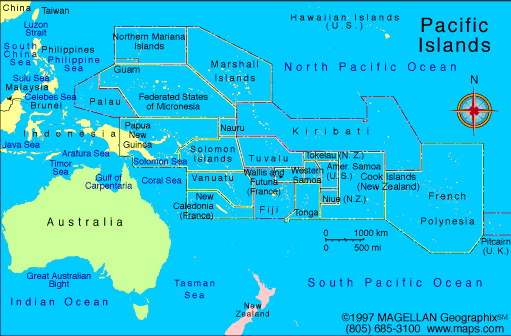
Map of Pacific Islands and Australia

Pacific Island nations have complex requirements for infrastructure.  It is tempting but foolish to see similarities and simply apply a one-size-fits-all.  

However, the best combination of infrastructure assets for Pacific Island nations will depend on the specific needs and resources of each individual nation. In general, however, there are a few key types of infrastructure that are important for the development and well-being of Pacific Island nations.

Transportation infrastructure: This includes roads, ports, airports, and other transportation networks that are necessary for the movement of people, goods, and services within the country and to other countries.

Energy infrastructure: This includes power plants, transmission and distribution networks, and other facilities that are necessary for the generation and distribution of electricity.

Telecommunications infrastructure: This includes networks of communication towers, cables, and other equipment that are necessary for providing telephone and internet services to the population.

Water and sanitation infrastructure: This includes systems for the treatment, distribution, and collection of water, as well as sewage treatment facilities and other infrastructure related to sanitation.

Health care infrastructure: This includes hospitals, clinics, and other facilities that are necessary for providing health care services to the population.

Educational infrastructure: This includes schools, universities, and other institutions that are necessary for providing education to the population.

It is important for Pacific Island nations to have a balanced and well-developed infrastructure system in order to support economic growth, improve living standards, and enhance the overall well-being of the population.  It means having an approach that enables strategic consideration and appraisal of a diverse combination of assets across a diverse set of countries.

Categories
Coronavirus Economics Infrastructure Policy

Impact of Coronavirus on Infrastructure – Initial Thoughts

Mid afternoon snap of LA traffic. Usually at this time of day it would be bumper-to-bumper. The Governor of California has ordered the State’s 40 million citizens to stay home, restricting non-essential movements. Source: The Mercury News, CA.

The coronavirus pandemic will have significant impacts on how we design, develop, fund and operate infrastructure. As the pandemic evolves, the nature of these impacts will emerge, creating increasing risks. There is a stark difference between the impact of the Global Financial Crisis (GFC) and this pandemic. The former was initially a financial liquidity impact that affected cash flows around infrastructure investment and operation.  

The pandemic’s first impacts are likely to be around the loss of human capacity in the systems that support this complex sector. The near term impacts are likely to be more associated with loss of certainty, affecting planning, operation and funding of infrastructure.

There is a range of considerations; which will have varying degrees of impact on governments, communities, organisations and people.

i) Demand-based assets are vulnerable because of the drop in use as with the coronavirus takes away discretionary spending. This particularly so for transport infrastructure, which directly engages with end consumers. Supply chains for these assets will be affected.

ii) Contracted assets have some increasing counterparty risk. Energy assets, for example, depend on the continuing creditworthiness of their counterparties. Many utility services may be called on by state actors to contribute to the overall effort to address the economic impacts of coronavirus.

iii) Merchant infrastructure potentially faces higher volatility in commodity prices and heightened uncertainty of demand. This kind of infrastructure operates at the margin of markets, rather than profiting from significant baseload provision at low, guaranteed margins. It will vary across markets for infrastructure services.

iv) Some specialised infrastructure has exposure to sports. This group of assets has both contracted and demand-based revenues. In Australia, we see the challenges facing our principal football codes with the loss of stadium revenues. It has exposed football codes that have not been developing multi-year contracts for stadiums and areas, and cannot defer refunds and provide credits for future ticket purchases. Some infrastructure owners have not undertaken sufficient risk analysis to determine the financial reserves for significant events.

v) Expect construction delays and cost increases as labour and material shortages occur, as well as the introduction of appropriate occupational health and safety processes are developed to address coronavirus.

vi) Expect the possibility of some operating underperformance of infrastructure assets associated with possible labour and material shortages. As operating environments are adjusted, with some delays in scheduled maintenance, this should only be a short-term impact. Retaining the capacity to do critical maintenance is essential.

vii) Contractual triggering of force majeure declarations may become more likely. The effectiveness of these declarations will depend on the specific wording in each contract, which may create many disputes around non-performance.

viii) Policy exclusions in business interruption insurance may affect the ability of infrastructure asset owners and operators to respond. Management teams are going to have to think more about internal liquidity policies and how to structure their cash flows in both infrastructure transactions and operations.

ix) The debt position infrastructure owners and operators will be compounded by refinancing challenges. More volatile credit markets mean more considerable uncertainty about the costs of refinancing when it is needed. Understanding debt maturation profiles and alternatives will be essential. Assets with long concession periods or very long useful lives possibly have a better ability to manage their short term debt profiles.

Some of these risks might be mitigated in part by the following:

i) Government intervention is more likely to occur. While some government actions might have adverse impacts. Across a range of infrastructure classes, governments might take interaction to support the overall performance of the economy.

ii) Infrastructure businesses are more protected at the enterprise level. Many firms operate in multiple markets and hold multiple sets of infrastructure assets. Also, many infrastructure businesses operate long-live assets with capex plans that can be modified and significant management discretion on operational tempo and allocation of surpluses.

iii) Infrastructure projects typically have strong capital structures. How cash flows are applied is tied to contractual requirements and ensuring funds flow to relevant parties. This is the core of traditional project financing. Infrastructure projects without recourse to full cash-funded debt reserves are exposed to prolonged delays and a slow economic recovery.

Our response to coronavirus is only limited by our understanding of it and our ability to imagine and execute solutions.

Categories
Lytton Advisory

City Infrastructure

Thanks, Gene (Adept Economics) for hosting me on an episode of your podcast series Economics Explained. It was great we were able to unpack a few things about city infrastructure for your listeners, particularly regarding Brisbane’s Green Bridges program and Cross River Rail.

Categories
Cost Benefit Analysis Economics Infrastructure Lytton Advisory

Economics of Infrastructure Podcast

Image result for podcast

Thanks to Gene Tunny, Principal at Adept Economics, for inviting me onto his new podcast series – Economics Explained. We discussed the nature of infrastructure, the services these assets supply and how good economic analysis helps select better infrastructure projects. Gene and I have collaborated on a number of projects over the last two years. He is a leading independent economist who blogs regularly at queenslandeconomywatch.com.

You can listen to the podcast here: https://queenslandeconomywatch.com/2019/09/16/economics-of-infrastructure-interview-with-craig-lawrence-of-lytton-advisory/

Categories
Economics Infrastructure Policy

State of Play for Infrastructure in Queensland

In this guest post, Queensland Economic Advisory Services Director, Nick Behrens, shares his thoughts about the State Infrastructure Plan. Nick was part of part of an expert panel commenting on the 2019 State Infrastructure Plan at the recent Infrastructure Association of Queensland special breakfast. Nick is a Senior Associate with Lytton Advisory.

State Infrastructure Plan plays to division between SEQ and Regional Queensland.

The recently released State Infrastructure Plan (SIP) provides a much needed framework for the planning and prioritising of infrastructure delivery in Queensland and should be widely supported.

However, it also reinforces subconsciously the division that exists between SEQ and Regional Queensland when it comes to limited infrastructure dollars being spread across a large and high needs state.

The SIP outlines a $49.5 billion infrastructure program over the next four years from the Queensland Government ($12.9 billion in 2019-20) that claims to be supporting an estimated 40,500 jobs. Based on these metrics alone it is delivering economic development at a time when overall economic growth in Queensland is below trend.

Since the original SIP was released in 2016, Queensland has experienced significant changes including our population growing to more than five million, changing regional economies, and advanced technologies altering both infrastructure and service delivery.

As a result the 2019 SIP details the infrastructure investment strategy and delivery program for the next four years, in order to provide the private sector and other levels of government with clear direction of what is in the pipeline.

The Queensland Government’s SIP mantra is ensuring the right infrastructure is delivered in the right place and at the right time to meet the demands of a growing state. This is a commendable goal of any government and one that directly aligns with community and industry expectation.

If the document has one regrettable feature it is the cementing of an ‘us’ and ‘them’ attitude when it comes to infrastructure rollout across Queensland. For example the SIP reads “Importantly, about 60 per cent of the capital program and 25,500 of the jobs supported are outside the Greater Brisbane area.”

Much of the narrative of a fair split between the two parts of the State is about a political necessity following the Federal Election result whereby Queensland Labor were wiped out north and west of Brisbane.

As an illustration of this point, the 2019 SIP is 207 pages long verses 159 pages back in 2018 and these extra 48 pages are directly up front and relate purposefully to what the Queensland Government is doing in infrastructure delivery in regional Queensland.

It is not wrong to support regional Queensland but constructing a zoning of spend is counter to the commendable objectives of SIP in supporting economic development, increased productivity and the creation of communities in which people want to live across all of Queensland.

The reality is, what benefits SEQ undoubtedly benefits Regional Queensland and vice-versa when it comes to infrastructure.

Glowing examples of this point are the Gateway North Upgrade and Toowoomba Second Range Crossing whereby freight is passaged through these assets that benefits Regional Queensland. On the other side of the coin is investment in rail and ports in regional Queensland is enabling royalties for frontline service delivery in SEQ. The right narrative is a symbiotic relationship between the South East Corner and all of Regional Queensland.

Putting aside the politics, what the SIP really does is highlight how incredibly difficult infrastructure delivery and prioritisation is in Queensland. Our State has the unfaltering complexity of higher economic and population growth in SEQ meaning we are continually behind the infrastructure roll out curve and yet we have the geographical size, decentralised population and low population densities of regional Queensland.

All of which mean the road, rail, electricity transmission and electricity distribution kilometres are higher than other states and we require more airports and seaports. Quite simply infrastructure delivery in Queensland is complex and difficult – with differing priorities benefiting differing areas at differing times.

In summary, the SIP represents a very good iteration or constant continuing roll out of enabling projects for Queensland. Looking past the politics of its presentation it is investing in critical infrastructure and is in fact investing in a positive future for the Sunshine State.

The schools and TAFE are delivering the skills our economy requires. The bridges, roads, ports and rail are enabling our exports to get to market and commerce to flow. The electricity and water assets are providing the vital inputs for our economy.

The overall spend as impressive as it sounds is still low by historical percentage of GSP standards but the SIP has been well received from many communities and industry sectors and rightly so.

The plan can be found here:
https://www.dsdmip.qld.gov.au/resources/plan/sip/sip-part-b-2019.pdf

Categories
Cost Benefit Analysis Economics Infrastructure Lytton Advisory Policy

6th Anniversary

Economic Effects of Infrastructure Investment and its Financing

Today marks the sixth anniversary of Lytton Advisory as an independent economic consulting practice. Over that time, we have worked on a wide range of economic issues. This has taken us to places as diverse as the Solomon Islands, Papua New Guinea, Kuwait and Saudi Arabia.

We have never lost our enthusiasm for helping clients make smarter capital investment decisions. Neither have we wavered in our passion for proper planning, prioritisation and funding of infrastructure. In more recent years, our work has been around leading project teams of committed, experienced economists and professionals to bring high conviction analyses to our clients. Good cost benefit analysis is at the heart of what we do.

In the first half 2019 founder, Craig Lawrence took, in effect, a sabbatical from the practice to lead the establishment of the Economic and Social Infrastructure Program in PNG. This $130 million 4+4 year Cardno-delivered, Australian Government funded program seeks to improve the quality of planning, prioritisation and funding of infrastructure to achieve economic outcomes and social development goals for Papua New Guineans.

Whether it is: developing an investment manual to incorporate climate change adaptation in infrastructure development decisions in the Solomons; a full cost pricing algorithm for food and drug regulatory services in Saudi Arabia; or generating savings from waste transfer station closures that fund a ten-year capital works program – Lytton Advisory is up for the challenge. At every stage, it is about driving value for the clients and communities affected by infrastructure.

We are excited about the future for infrastructure, its contribution to sustainable economic and social development, and how emerging economic incentives, new social paradigms and innovative technologies are shaking up these services.

Categories
Cost Benefit Analysis Economics Infrastructure

Surfing the Pipe

Building Queensland has released its latest Infrastructure Pipeline Report.  It shows how the Queensland Government is addressing the State Infrastructure Plan, and how this relates to funding by the Commonwealth Government.

Queensland faces big challenges.  Population growth and ageing, ageing infrastructure assets and increased demand for social infrastructure, and constrained funding envelopes.  These challenges require innovative thinking around services, assets, operations, funding and financing.

The Report highlights how a staged business case process can drive value for the State infrastructure spend before final funding decisions are made.  It also makes very transparent which projects the State has to decide to actually fund. The infrastructure pipeline is informing Queensland Government investment decisions with 23 proposals funded since our first report in June 2016

The importance of the Infrastructure Pipeline Report is in the credibility of the project development path for projects.  Since 2016 the Pipeline has informed Queensland Government investment decisions to fund 23 proposals.  This level of transparency attracts a lot of focus, energy and resources from the private sector.  It also enables longer-term planning by businesses to anticipate future project delivery needs.

The credibility of this Pipeline is in stark contrast to the rash of unfunded announcements that were made by governments in the past, leading to ridiculous capital works programs that were never delivered.

Publicly released independent reviews of business cases and, in particular, the mandatory cost-benefit analyses, would strengthen this further.

The 2019 Infrastructure Pipeline Report can be found at:

Click to access Infrastructure-Pipeline-Report-2019.pdf