Categories
Cost Benefit Analysis development Economics Policy

Understanding Appraisal Periods in Cost-Benefit Analysis: Insights for Long-Term Investments

Accurately determining the period of appraisal in cost-benefit analysis is vital for effective decision-making, particularly for finance ministry officials in Pacific Island nations. This strategic understanding significantly influences economic stability and growth in the region.

The period of appraisal refers to the time span over which a project’s costs and benefits are evaluated. Getting this right shapes the analysis and directly affects the perceived feasibility of a project. Selecting an appropriate timeframe ensures all relevant costs and benefits are considered, especially for long-term projects like infrastructure or environmental programs that might produce benefits years later.

The appraisal period should align with the expected life of the asset or investment. For projects with long lifespans, the period should cover decades to fully capture their potential benefits. Both short- and long-term economic benefits need to be accounted for. Furthermore, a well-defined appraisal period is significant in determining the relevance of residual values in project evaluation. Residual values represent the remaining worth of an asset at the end of the appraisal period. If this period is too short, the analysis may underestimate the project’s true value by overlooking residual worth.

Understanding the distinction between economic and financial analysis is also crucial. Financial analysis focuses on investor cash flow and profitability, while economic analysis examines the broader societal impact, including externalities. This broader perspective often requires a longer appraisal period than financial analysis.

It’s also essential to differentiate between the period of appraisal and the tenor of funding, which is the timeframe over which borrowed funds are repaid. Misalignment between the two can skew financial assessments and lead to underestimating a project’s long-term value.

When managing multiple projects, consistency in the appraisal period is vital. Using a consistent time horizon across similar projects enables meaningful comparisons and strategic planning, ensuring investment decisions align with national economic goals.

Equipped with this understanding, finance ministry officials can ensure investment strategies prioritise financial viability and broader economic benefits over each project’s entire lifespan.

#CostBenefitAnalysis #EconomicGrowth #InvestmentPlanning #SustainableInvestments #PacificIslands

Categories
Cost Benefit Analysis development Economics

Appointment

Talofa! Lytton Advisory is pleased to announce that its Managing Director – Craig Lawrence – has been contracted by the Asian Development Bank as an Economist / Cost Benefit Analysis (CBA) expert to assist the Government of Samoa’s Ministry of Finance (MoF)  

Craig will be working with MoF officials to help strengthen the capacity of the Economic Policy and Planning team to produce timely cost-benefit analyses, improve data collection and provide advice to support decision making. 

Categories
development Economics Infrastructure

AI Infrastructure Planning in the Pacific?

Recently Lytton Advisory is seeing Artificial Intelligence (AI) being applied across a wide range of sectors of economies.  Currently we are engaged in national infrastructure investment planning in Samoa and Vanuatu.  This prompted us to think about some of the issues around using AI in national infrastructure investment planning.  It is a promising approach that can enhance efficiency, precision, and foresight. However, implementing this technology, especially in Pacific Island nations, is not without challenges.  Three big challenges we see are:

  • Limited Access to Quality Data: AI thrives on large, diverse, and high-quality datasets. For AI to be effective in infrastructure planning, it needs access to data on the current state of the infrastructure, usage patterns, environmental factors, and the like. However, in many Pacific Island nations, data collection and management practices may be underdeveloped due to resource limitations, which results in poor quality or incomplete datasets. These nations may lack the digital infrastructure, like advanced sensor networks, to gather sufficient real-time data for AI to work effectively. The issue of data privacy and protection also comes into play, given the sensitive nature of certain infrastructure-related data.
  • Technological Capacity and Expertise: The implementation of AI requires technical expertise and strong digital infrastructure. In many Pacific Island nations, these capacities may be lacking due to constraints in resources, education, and infrastructure. Training locals to use and manage AI systems could be difficult, and attracting or retaining AI talent may also be a challenge due to economic factors and brain drain. There’s also the task of integrating AI with existing systems, which could be outdated or incompatible.
  • Environmental Vulnerability: Pacific Island nations are among the most vulnerable to climate change. Frequent natural disasters like cyclones, flooding, and sea-level rise create an unpredictable environment for infrastructure planning. While AI could potentially help manage and adapt to these issues, the volatile environment also makes data collection and analysis more challenging. Infrastructure and equipment needed for AI, such as data centers and sensor networks, could also be damaged by environmental events.

To overcome these challenges, it’s essential to adopt a strategic approach that includes improving data management practices, investing in education and digital infrastructure, promoting technological capacity building, and implementing robust measures to mitigate environmental risks.

Trying to do this at a national level may be limiting, especially for some of the very small nations of the Pacific.  Developing AI on a regional Pacific basis, rather than a series of national ones, might bring some of the following benefits:

  • Shared Resources: AI development requires substantial resources, including technology, data, and skilled professionals. By pooling resources at a regional level, Pacific Island nations can collectively create more robust AI systems than they might individually. They can share the costs of necessary infrastructure, the development of AI applications, and the hiring or training of experts.
  • Standardization and Interoperability: A regional approach can foster standardization of data formats, protocols, and AI technologies. This makes systems more interoperable across countries, which can facilitate cross-border initiatives and collaborations. This is particularly useful for the Pacific Island nations given their geographical proximity and shared regional challenges.
  • Shared Data: AI relies heavily on data for training and functioning. By pooling data at a regional level, nations can create larger and more diverse datasets, which can help improve the accuracy and reliability of AI systems. This can also compensate for the smaller population sizes and hence smaller national datasets of these nations.
  • Regional Adaptation: Given that Pacific Island nations face similar environmental challenges, such as climate change and natural disasters, a regional AI system can be designed to specifically tackle these issues. AI models could be trained to predict and respond to regional weather patterns, sea-level rises, and natural disasters, aiding in preparedness and mitigation strategies.
  • Collective Bargaining: A region acting as a unified entity has a stronger position when negotiating with global tech companies or other international entities. This can lead to more favorable terms in data privacy, technology transfer, and intellectual property rights.
  • Capacity Building and Learning: A regional approach encourages collaboration and exchange of knowledge and best practices among nations. This can help build capacities in AI and related fields across the region, further fostering a regional tech ecosystem.

While a regional approach offers these advantages, it also presents its own challenges such as coordinating between different national interests and regulations, data privacy concerns, and managing shared resources equitably. Therefore, a balance between regional cooperation and national autonomy needs to be found.

International cooperation could play a vital role in providing the necessary resources and expertise, particularly in kick-starting a regional approach. It’s crucial to develop AI systems with an understanding of local contexts and needs, as well as appropriate safeguards for data privacy and security.

Categories
Economics Infrastructure Lytton Advisory

Risks of building infrastructure in the Pacific

Taking a broader view of construction risk management

The unique nature of the Pacific poses several large risks in building infrastructure in Pacific Island nations.  While the risks are not necessarily unique to the Pacific, the potential combination of these factors can increase the overall risk profile of building infrastructure in the Pacific and might require stronger risk responses.  The following six factors are worth considering.

Natural disasters: Pacific Island nations are prone to earthquakes, cyclones, and other natural disasters, which can damage or destroy infrastructure projects.

Political instability: Political instability in Pacific Island nations can lead to changes in government policies, which can affect the financing and completion of infrastructure projects.

Limited financial resources: Many Pacific Island nations have limited financial resources, which can make it difficult to fund infrastructure projects.

Limited skilled labor: Many Pacific Island nations have a limited pool of skilled labor, which can make it difficult to find workers to complete infrastructure projects.

Environmental concerns: Building infrastructure in Pacific Island nations often requires the use of natural resources and the modification of the landscape, which can raise environmental concerns.

Cultural sensitivity: Building infrastructure in Pacific Island nations requires sensitivity to the cultural traditions and values of the local communities, which can present challenges.

A risk approach that does not consider these elements is inherently risky. How do you handle this kind of risk in your organisation?

Categories
development Economics Infrastructure

Appointment

Lytton Advisory is pleased to announce that Managing Director Craig Lawrence has been appointed to a Panel of Economic Experts for Australia’s Solomon Island Resource Facility (ASRIF).

ASIRF supports the Department of Foreign Affairs and Trade in meeting the objectives of Australia’s aid program in the Solomon Islands.

Craig previously advised the Ministry of Infrastructure Development there on how to incorporate economic tools to assess climate change adaptation strategies into the transport invesment guidelines.

This year marks the tenth anniversary of Lytton Advisory’s engagement with Pacific Island nations on a range of economic and infrastructure issues.

Categories
Economics Infrastructure Lytton Advisory

When does infrastructure planning fail?

Top 10 Traps & Tips: Why Infrastructure Projects Fail - ArcBlue.com

Decision-makers do not get it right all the time.  Understanding potential avenues of failure provides a good basis for being able to identify risks associated with failure and develop strategies to avoid them.  Avoidable errors always seem more egregious than unforced ones. Infrastructure planning can often fail due to a variety of reasons.  

Lack of long-term vision: Infrastructure projects often have long lifespans, and it is important to have a clear vision of the future needs of the community in order to plan effectively. If the infrastructure is not designed to meet the needs of the community in the long term, it may become outdated or inadequate.

Insufficient funding: Infrastructure projects can be expensive, and if there is not sufficient funding available to complete the project, it may not be feasible to proceed. This can be especially challenging when infrastructure projects are designed to serve a large, diverse community with a variety of needs.

Political considerations: Infrastructure projects can be influenced by political considerations, such as the interests of local politicians or the preferences of specific groups within the community. This can lead to projects being implemented that do not fully consider the needs of the community as a whole.

Poor coordination: Infrastructure projects often involve multiple stakeholders, including government agencies, private companies, and community organizations. If these stakeholders are not effectively coordinated, it can lead to delays, cost overruns, and other problems.

Environmental and social impacts: Infrastructure projects can have environmental and social impacts that are not fully considered during the planning process. For example, a highway project may disrupt natural habitats or displace communities, leading to negative consequences for the environment and local residents.

Technological advancements: Infrastructure projects may be designed and built using technologies that become outdated or inferior to newer alternatives. This can lead to problems with the performance and maintenance of the infrastructure, and may require costly upgrades or replacements.

Planning frameworks that do not address these issues imperil successful delivery of infrastructure over time.

How do you manage planning risk in your organisation? I would be keen to read your views in the comments.

Categories
Infrastructure Lytton Advisory Policy

What is the best way to screen infrastructure proposals?

Infrastructure Planning

Recently I have been thinking about how early-stage screening of infrastructure proposals can be made more effective. Time and again I see lists of projects here in Australia that are unfunded, undeveloped and, frankly, never-deliverable.

A key element of good infrastructure planning is the capture of the complete suite of proposals that could be under consideration at a point in time.  This is critical for national infrastructure planning.  Part of this also needs to consider the best way to screen all of these proposals, so determine which ones might be come investment ready projects.  There are several best practices that can be followed when screening infrastructure proposals.

Identify the goals and objectives of the project: It is important to have a clear understanding of the purpose and potential impacts of the project. This will help to ensure that the proposal aligns with the goals and objectives of the organization or community.

Evaluate the feasibility of the proposal: Consider the technical feasibility of the proposal, including whether the proposed solution is technically sound and can be implemented within the available resources.

Assess the financial viability of the proposal: Determine the costs associated with the proposal and consider the potential return on investment.

Consider the environmental and social impacts: Infrastructure projects can have significant environmental and social impacts. It is important to consider these impacts and ensure that the proposal takes them into account.

Involve stakeholders in the process: Engage with stakeholders, including community members, local businesses, and other interested parties, to gather input and ensure that the proposal is responsive to the needs and concerns of the community.

Utilize a formal proposal review process: Establish a formal process for reviewing and evaluating proposals, including the use of a proposal review committee or panel to evaluate and provide recommendations on proposals.

I wonder how many proposals processes check off against these issues. What has been your experience?

Categories
Economics Infrastructure Lytton Advisory

What are the infrastructure priorities in the Pacific?

Infrastructure: Definition, Meaning, and Examples

A significant challenge in developing infrastructure plans is prioritising the pattern of infrastructure investment.  In the Pacific, the infrastructure priorities of island nations are likely to vary depending on the specific needs and resources of each individual country. However, there are some common priorities that may be considered.

Transportation: Many Pacific Island nations rely on air and sea transportation for the movement of goods and people. Improving and expanding transportation infrastructure, such as airports, ports, and roads, can help facilitate economic development and improve connectivity within and between islands.

Energy: Many Pacific Island nations rely heavily on fossil fuels for energy, which can be expensive and environmentally harmful. Prioritising the development of renewable energy sources, such as solar and wind power, can help reduce reliance on fossil fuels and improve energy security.

Water and sanitation: Access to clean water and proper sanitation facilities is essential for public health. Improving water and sanitation infrastructure can help reduce the incidence of waterborne diseases and improve overall health outcomes.

Communications: Improving telecommunications infrastructure, such as internet connectivity and mobile phone networks, can help connect remote communities and facilitate economic development.

Healthcare: Access to healthcare is often limited in Pacific Island nations due to limited infrastructure and resources. Improving healthcare infrastructure, such as hospitals and clinics, can help ensure that people have access to essential healthcare services.

In addition to sectoral-focussed opportunities, there may also be individual, specific large scale projects that are part of a broader pattern of planned national development.  

Context is King in formulating priorities, but it does require an underlying framework of agreed infrastructure classification as well as a set of priority values which potential projects can be examined.

Categories
Economics Infrastructure Lytton Advisory

Good Infrastructure in the Pacific

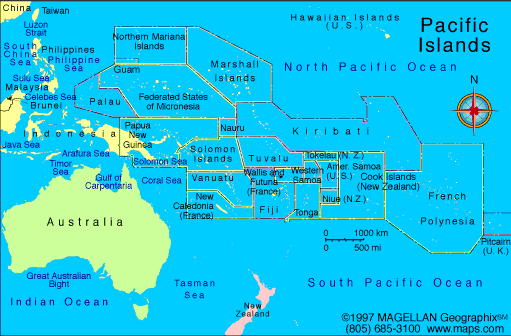
Map of Pacific Islands and Australia

Pacific Island nations have complex requirements for infrastructure.  It is tempting but foolish to see similarities and simply apply a one-size-fits-all.  

However, the best combination of infrastructure assets for Pacific Island nations will depend on the specific needs and resources of each individual nation. In general, however, there are a few key types of infrastructure that are important for the development and well-being of Pacific Island nations.

Transportation infrastructure: This includes roads, ports, airports, and other transportation networks that are necessary for the movement of people, goods, and services within the country and to other countries.

Energy infrastructure: This includes power plants, transmission and distribution networks, and other facilities that are necessary for the generation and distribution of electricity.

Telecommunications infrastructure: This includes networks of communication towers, cables, and other equipment that are necessary for providing telephone and internet services to the population.

Water and sanitation infrastructure: This includes systems for the treatment, distribution, and collection of water, as well as sewage treatment facilities and other infrastructure related to sanitation.

Health care infrastructure: This includes hospitals, clinics, and other facilities that are necessary for providing health care services to the population.

Educational infrastructure: This includes schools, universities, and other institutions that are necessary for providing education to the population.

It is important for Pacific Island nations to have a balanced and well-developed infrastructure system in order to support economic growth, improve living standards, and enhance the overall well-being of the population.  It means having an approach that enables strategic consideration and appraisal of a diverse combination of assets across a diverse set of countries.

Categories
development Economics Infrastructure Policy

Q&A With David Baxter, PPP Navigator and Infrastructure Specialist

ppp-infrastructureI chatted recently with David Baxter, an infrastructure specialist with significant experience in public-private partnerships. He shared some of his insights with me.

He gave me some meaningful comments regarding challenges facing governments in providing public infrastructure and how commercial interest can be created, risks shared and benefits for communities achieved.

So how would you characterise recent PPP activity in the Pacific?

Much of the activity seems to be focused on small island nations or be tied into China’s Belt and Road Initiative. Although there is great merit in building up these island nation trade capabilities through the improvement of port and airport facilities, the following questions need to be asked:

  • Are these facilities being constructed in the interest of the host nations or are they being built for geopolitical leverage?
  • Can these small island nations and even bigger nations afford these projects?
  • Are adequate feasibility studies being done on the financial and commercial viability of the projects?
  • Are full and competitive procurements being pursued?
  • Is the long-term sustainability and resilience of PPP projects being considered?

Many countries have PPP policies in place and a PPP unit located in their Treasury or Finance departments. What are some of the biggest mistakes you have seen in implementing PPP policy?

The following are the most common that I see:

  • In many instances, the PPP Units are the initiators of PPP projects when they are imposed upon unwilling line ministries which have not always been consulted on the viability or desirability of projects.
  • Often the laws and best practices that are introduced, get ahead of institutional ability to implement the laws accordingly and so delays occur as everyone tries to meet requirements imposed by regulators.
  • In some instances, the PPP Units try to be autonomous of the Treasury or the Finance Ministry (for political reasons) and this then leads to conflict between the institutions that is not healthy in the long run.
  • Often the PPP Units do not have well define mandates and this leads to confusion on whether they should provide technical support to government institutions or whether they should be the initiator of PPPs. It is important that they realize that their activates should subject to national procurement laws and they are not a law unto themselves.

What characteristics do you think differentiate infrastructure PPPs from other types of PPPs?

Primarily the greater level of due diligence that needs to be completed on private sector partners due to the long-term commitments that are required and their ability to manage risk for 30 + years. Most typical contracts rely on the design-build element. PPPs require financing and O&M on top of this which requires that the public sector must monitor the performance of its long-term partner and the performance-based parameters.

What are the most significant conditions necessary to ensure an infrastructure PPPs is successful?

Appropriate allocation of risk during the feasibility, procurement, and contract award stages and monitoring and immediate mitigation of risk when it occurs.

PPPs are often seen as a panacea for difficult national budget circumstances. What are the risks around developing PPPs with this as the prime consideration?

In many instances, PPPs should not be implemented because they do not pass the litmus tests required such as Value for Money, commercial and financial feasibility, etc. They cannot be seen as an automatic panacea, it needs to be proven that proposed projects are viable and feasible as well as sustainable to be a panacea.

What governance arrangements are more effective for infrastructure PPPs?

Governments need to be fully engaged in the management of PPP contracts. They cannot step away and only engage the private sector partner when the close-out phase is reached. Many government employees do not understand the level of commitment required from their side and the need to have a technical understanding of PPPs to ensure that they are implemented correctly.

Is a rigorous public sector comparator really that important for an infrastructure PPP?

Most certainly in countries that are still developing or which are launching their first PPP projects. As PPP national markets mature, the private sector can become a more competent partner and this leads to a more trusting and professional collaboration.

PPPs often address a particular infrastructure service or need. How effective are they in addressing asset maintenance and preservation of benefit streams from existing infrastructure?

Brownfield PPP projects can be a minefield due to many unknowns. However, experience gleaned from existing projects and infrastructure can be beneficial – so it depends. However, I believe that every PPP project is unique and thus a certain amount of innovation is necessary to improve asset preservation and to do it better than it was done in the past. The goal should always be simple – do it better each time.

PPPs are inherently commercial in nature, as risk along with return is transferred to the private sector. How can social benefits and returns be properly incorporated in the development of PPPs?

I believe that this has to do with a mature and well-defined understanding of Value for Money: adherence to people first PPPs is an option as well as incorporating the SDGs into project goals and objectives. This can help project proponents determine the non-commercial elements of risk transfer in socially beneficial projects and the possible subsidies that might need to be introduced to offset non-commercial vitality pertaining to certain risks.

If every PPP had to contain one mandated element, what would that be?

By answering the following questions –

  • Why are we doing this as a PPPs?
  • Are we confident that this should be a PPP?

Good answers require completion of due diligence, gaining political support, full stakeholder engagement and full disclosure of all information to all private sector parties equally, so that they all understand the merits of the project.

If these answers cannot be motivated and supported fully – do not do it as a PPP.

David, thanks so much for making the time available to talk with us and share these insights.