Categories
Infrastructure Lytton Advisory Policy

What is the best way to screen infrastructure proposals?

Infrastructure Planning

Recently I have been thinking about how early-stage screening of infrastructure proposals can be made more effective. Time and again I see lists of projects here in Australia that are unfunded, undeveloped and, frankly, never-deliverable.

A key element of good infrastructure planning is the capture of the complete suite of proposals that could be under consideration at a point in time.  This is critical for national infrastructure planning.  Part of this also needs to consider the best way to screen all of these proposals, so determine which ones might be come investment ready projects.  There are several best practices that can be followed when screening infrastructure proposals.

Identify the goals and objectives of the project: It is important to have a clear understanding of the purpose and potential impacts of the project. This will help to ensure that the proposal aligns with the goals and objectives of the organization or community.

Evaluate the feasibility of the proposal: Consider the technical feasibility of the proposal, including whether the proposed solution is technically sound and can be implemented within the available resources.

Assess the financial viability of the proposal: Determine the costs associated with the proposal and consider the potential return on investment.

Consider the environmental and social impacts: Infrastructure projects can have significant environmental and social impacts. It is important to consider these impacts and ensure that the proposal takes them into account.

Involve stakeholders in the process: Engage with stakeholders, including community members, local businesses, and other interested parties, to gather input and ensure that the proposal is responsive to the needs and concerns of the community.

Utilize a formal proposal review process: Establish a formal process for reviewing and evaluating proposals, including the use of a proposal review committee or panel to evaluate and provide recommendations on proposals.

I wonder how many proposals processes check off against these issues. What has been your experience?

Categories
Economics Infrastructure Lytton Advisory

What are the infrastructure priorities in the Pacific?

Infrastructure: Definition, Meaning, and Examples

A significant challenge in developing infrastructure plans is prioritising the pattern of infrastructure investment.  In the Pacific, the infrastructure priorities of island nations are likely to vary depending on the specific needs and resources of each individual country. However, there are some common priorities that may be considered.

Transportation: Many Pacific Island nations rely on air and sea transportation for the movement of goods and people. Improving and expanding transportation infrastructure, such as airports, ports, and roads, can help facilitate economic development and improve connectivity within and between islands.

Energy: Many Pacific Island nations rely heavily on fossil fuels for energy, which can be expensive and environmentally harmful. Prioritising the development of renewable energy sources, such as solar and wind power, can help reduce reliance on fossil fuels and improve energy security.

Water and sanitation: Access to clean water and proper sanitation facilities is essential for public health. Improving water and sanitation infrastructure can help reduce the incidence of waterborne diseases and improve overall health outcomes.

Communications: Improving telecommunications infrastructure, such as internet connectivity and mobile phone networks, can help connect remote communities and facilitate economic development.

Healthcare: Access to healthcare is often limited in Pacific Island nations due to limited infrastructure and resources. Improving healthcare infrastructure, such as hospitals and clinics, can help ensure that people have access to essential healthcare services.

In addition to sectoral-focussed opportunities, there may also be individual, specific large scale projects that are part of a broader pattern of planned national development.  

Context is King in formulating priorities, but it does require an underlying framework of agreed infrastructure classification as well as a set of priority values which potential projects can be examined.

Categories
Economics

A Canada – America Comparison

Lytton Advisory is travelling in Canada and the United States during February. It presents an opportunity to compare and contrast two dynamic economic systems, as well as look at the underlying structure of these economies and how some of the cities operate (or don’t).

The economy of Canada is closely tied to that of the United States, as the two countries have a highly integrated trading relationship. However, there are some key differences between the two economies.

In terms of size, the United States has a larger economy than Canada. The GDP of the United States at around US$24 trillion is around 10 times larger than that of Canada.

In terms of composition, the economies of the two countries are similar, with both relying heavily on services and manufacturing. However, the United States has a larger agricultural sector, while Canada has a larger natural resources sector, particularly in oil and gas.

Both countries are heavily oriented towards external trade, with the United States and Canada being each other’s largest trading partners. However, the United States has a more diversified trade portfolio, with significant trade relationships with countries all over the world, while Canada’s trade is more heavily concentrated with the United States.

In terms of investment, the United States is generally considered to be a more attractive destination for foreign investment than Canada. The United States has a larger and more developed economy, as well as a more business-friendly environment. However, Canada is also a popular destination for foreign investment, particularly in the natural resources sector.

In terms of ease of doing business, the United States generally ranks higher than Canada. The World Bank’s Ease of Doing Business Index, the United States is ranked 7th while Canada is ranked 18th. However, there are some specific areas in which Canada is considered to be more business-friendly, such as labor laws and regulations.

Such a broad brush consideration of two large economies masks significant regional variations in each economy. It does identify some major themes however.

As a starting point, are these kinds of comparisons relevant, valid or useful? Let us know in the comments below.

Categories
Circular Economy Economics Policy Waste Management

Takeaways the key to a circular economy?

Following the NSW Government’s released of an independent review of its resource recovery framework and implications for the circular economy, three key takeaways struck me:

  • The review identified friction between the environment and safety objectives of the existing NSW waste and resource recovery framework and the need for flexibility to support innovation and a smooth transition to a circular economy.
  • A key criticism of the EPA was their handling of the revocation of the mixed waste organic material (MWOO) exemption in 2018. This led to recommendations for the resource recovery regime to be put on a similar footing to environmental and planning approval regimes.
  • The debate over the definition of waste continues, as the broad interpretation in the case of EPA v Grafil has potentially slowed the advancement of the circular economy.

The Review made a recommendation that the EPA should investigate a pathway to enable an “end-of-waste” outcome for suitable common, low-risk recovered materials to better enable reuse and promote circularity.

There were many other matters raised in the review, highlighting the challenges of both resource recovery and closing the loop between waste and input to future production processes.

You can read the full report here.

The balance between environmental protection, regulation to achieve that and innovation to drive the emergence of the circular economy is still being worked out.

How do you think this is being played out in other jurisdictions? What tradeoffs have to be made between effective environmental regulation and commercial innovation to achieve the circular economy?

Categories
Economics Local Government Lytton Advisory Waste Management

How do local governments manage waste costs?

Staying on top of municipal waste costs is a significant challenge for many local councils.  There are several ways local governments can manage these costs.

Implementing recycling programs: By promoting and facilitating recycling, local governments can reduce the amount of waste going to landfills, which can help lower disposal costs.

Negotiating contracts with waste management companies: Local governments can negotiate contracts with waste management companies to secure lower prices for waste disposal.

Implementing pay-as-you-throw programs: These programs charge residents based on the amount of waste they generate, encouraging them to reduce their waste and lower their costs.

Promoting waste reduction: Local governments can promote waste reduction initiatives, such as composting, to reduce the overall amount of waste generated in the community.

Partnering with private sector companies: Local governments can partner with private sector companies to create new waste management technologies or recycle more materials.

Implementing waste-to-energy programs: Some local governments have implemented waste-to-energy programs, which use waste as a fuel source to generate electricity, reducing the need for traditional fossil fuels and lowering energy costs.

To what extent is your local government doing some, all or even more than this?

Categories
development Economics Infrastructure Lytton Advisory

Appointment

Lytton Advisory is pleased to advise that in December 2022 Craig Lawrence was appointed as a consultant to the Pacific Regional Infrastructure Facility (https://www.theprif.org/what-we-do).

He will be assisting PRIF by helping Pacific Island states develop national infrastructure investment plans to drive economic and social development.

Craig is Managing Director of Lytton Advisory. For the past nine years he has led teams of economists examining infrastructure and public policy issues.

Categories
Cost Benefit Analysis Economics

Opportunity Cost

Like many folk over the summer holiday, I played around with ChatGPT, a natural language AI.

Being an economist, I asked for the meaning of Opportunity Cost, a foundation concept in economics. The response was deadly boring.

So I asked it to flick a switch and give it as a sonnet:

Opportunity cost, a term so fine,
Refers to the cost of choice not made,
The next best option left behind,
When one decision is the one laid.

It’s something we encounter every day,
From big choices to the small and meek,
But often we don’t stop and weigh
The cost of what we choose to seek.

So think before you act, consider well,
The path you take and what it means to stray,
For opportunity cost will dwell
In every choice you make, come what may.

So choose with care and wisely weigh,
The cost of all the options in play.

ChatGPT

This might be all a bit too much for those in the C Suites, so here is your executive haiku:

Opportunity lost

When a choice is made and done

Cost of the next best.

ChatGPT

Enjoy!

Categories
Economics Infrastructure Lytton Advisory

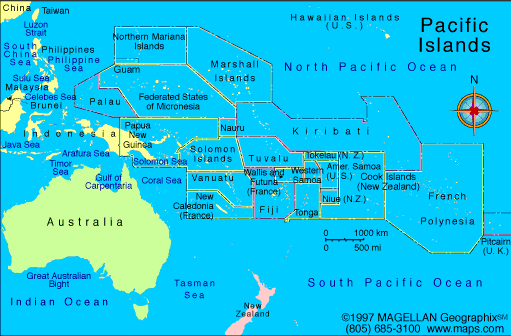
Good Infrastructure in the Pacific

Map of Pacific Islands and Australia

Pacific Island nations have complex requirements for infrastructure.  It is tempting but foolish to see similarities and simply apply a one-size-fits-all.  

However, the best combination of infrastructure assets for Pacific Island nations will depend on the specific needs and resources of each individual nation. In general, however, there are a few key types of infrastructure that are important for the development and well-being of Pacific Island nations.

Transportation infrastructure: This includes roads, ports, airports, and other transportation networks that are necessary for the movement of people, goods, and services within the country and to other countries.

Energy infrastructure: This includes power plants, transmission and distribution networks, and other facilities that are necessary for the generation and distribution of electricity.

Telecommunications infrastructure: This includes networks of communication towers, cables, and other equipment that are necessary for providing telephone and internet services to the population.

Water and sanitation infrastructure: This includes systems for the treatment, distribution, and collection of water, as well as sewage treatment facilities and other infrastructure related to sanitation.

Health care infrastructure: This includes hospitals, clinics, and other facilities that are necessary for providing health care services to the population.

Educational infrastructure: This includes schools, universities, and other institutions that are necessary for providing education to the population.

It is important for Pacific Island nations to have a balanced and well-developed infrastructure system in order to support economic growth, improve living standards, and enhance the overall well-being of the population.  It means having an approach that enables strategic consideration and appraisal of a diverse combination of assets across a diverse set of countries.

Categories
Lytton Advisory

Supporting Queensland

Queensland unveils funding to connect employers with skilled workers -  Australian Manufacturing

Lytton Advisory is pleased to announce that the Queensland Government has extended our engagement for a further two years on:

Whole of Government Standing Offer Arrangement for the Provision of Professional Services (SOA reference number: QGP0050-18)

with approval to supply the following services:

Economics
(forecasting, modelling, revenue review, advanced analytics)

We look forward to working with colleagues in agencies across the Queensland Government service.

Categories
Lytton Advisory

Growing your business

Are you thinking of growing your business to the next level? 

Is your turnover between $2 million to $20 million a year? 

Contact us at Lytton Advisory for a no-obligation free consultation.