Categories
Infrastructure Lytton Advisory Policy

What is the best way to screen infrastructure proposals?

Infrastructure Planning

Recently I have been thinking about how early-stage screening of infrastructure proposals can be made more effective. Time and again I see lists of projects here in Australia that are unfunded, undeveloped and, frankly, never-deliverable.

A key element of good infrastructure planning is the capture of the complete suite of proposals that could be under consideration at a point in time.  This is critical for national infrastructure planning.  Part of this also needs to consider the best way to screen all of these proposals, so determine which ones might be come investment ready projects.  There are several best practices that can be followed when screening infrastructure proposals.

Identify the goals and objectives of the project: It is important to have a clear understanding of the purpose and potential impacts of the project. This will help to ensure that the proposal aligns with the goals and objectives of the organization or community.

Evaluate the feasibility of the proposal: Consider the technical feasibility of the proposal, including whether the proposed solution is technically sound and can be implemented within the available resources.

Assess the financial viability of the proposal: Determine the costs associated with the proposal and consider the potential return on investment.

Consider the environmental and social impacts: Infrastructure projects can have significant environmental and social impacts. It is important to consider these impacts and ensure that the proposal takes them into account.

Involve stakeholders in the process: Engage with stakeholders, including community members, local businesses, and other interested parties, to gather input and ensure that the proposal is responsive to the needs and concerns of the community.

Utilize a formal proposal review process: Establish a formal process for reviewing and evaluating proposals, including the use of a proposal review committee or panel to evaluate and provide recommendations on proposals.

I wonder how many proposals processes check off against these issues. What has been your experience?

Categories
Economics Infrastructure Lytton Advisory

What are the infrastructure priorities in the Pacific?

Infrastructure: Definition, Meaning, and Examples

A significant challenge in developing infrastructure plans is prioritising the pattern of infrastructure investment.  In the Pacific, the infrastructure priorities of island nations are likely to vary depending on the specific needs and resources of each individual country. However, there are some common priorities that may be considered.

Transportation: Many Pacific Island nations rely on air and sea transportation for the movement of goods and people. Improving and expanding transportation infrastructure, such as airports, ports, and roads, can help facilitate economic development and improve connectivity within and between islands.

Energy: Many Pacific Island nations rely heavily on fossil fuels for energy, which can be expensive and environmentally harmful. Prioritising the development of renewable energy sources, such as solar and wind power, can help reduce reliance on fossil fuels and improve energy security.

Water and sanitation: Access to clean water and proper sanitation facilities is essential for public health. Improving water and sanitation infrastructure can help reduce the incidence of waterborne diseases and improve overall health outcomes.

Communications: Improving telecommunications infrastructure, such as internet connectivity and mobile phone networks, can help connect remote communities and facilitate economic development.

Healthcare: Access to healthcare is often limited in Pacific Island nations due to limited infrastructure and resources. Improving healthcare infrastructure, such as hospitals and clinics, can help ensure that people have access to essential healthcare services.

In addition to sectoral-focussed opportunities, there may also be individual, specific large scale projects that are part of a broader pattern of planned national development.  

Context is King in formulating priorities, but it does require an underlying framework of agreed infrastructure classification as well as a set of priority values which potential projects can be examined.

Categories
Economics Local Government Lytton Advisory Waste Management

How do local governments manage waste costs?

Staying on top of municipal waste costs is a significant challenge for many local councils.  There are several ways local governments can manage these costs.

Implementing recycling programs: By promoting and facilitating recycling, local governments can reduce the amount of waste going to landfills, which can help lower disposal costs.

Negotiating contracts with waste management companies: Local governments can negotiate contracts with waste management companies to secure lower prices for waste disposal.

Implementing pay-as-you-throw programs: These programs charge residents based on the amount of waste they generate, encouraging them to reduce their waste and lower their costs.

Promoting waste reduction: Local governments can promote waste reduction initiatives, such as composting, to reduce the overall amount of waste generated in the community.

Partnering with private sector companies: Local governments can partner with private sector companies to create new waste management technologies or recycle more materials.

Implementing waste-to-energy programs: Some local governments have implemented waste-to-energy programs, which use waste as a fuel source to generate electricity, reducing the need for traditional fossil fuels and lowering energy costs.

To what extent is your local government doing some, all or even more than this?

Categories
development Economics Infrastructure Lytton Advisory

Appointment

Lytton Advisory is pleased to advise that in December 2022 Craig Lawrence was appointed as a consultant to the Pacific Regional Infrastructure Facility (https://www.theprif.org/what-we-do).

He will be assisting PRIF by helping Pacific Island states develop national infrastructure investment plans to drive economic and social development.

Craig is Managing Director of Lytton Advisory. For the past nine years he has led teams of economists examining infrastructure and public policy issues.

Categories
Economics Infrastructure Lytton Advisory

Good Infrastructure in the Pacific

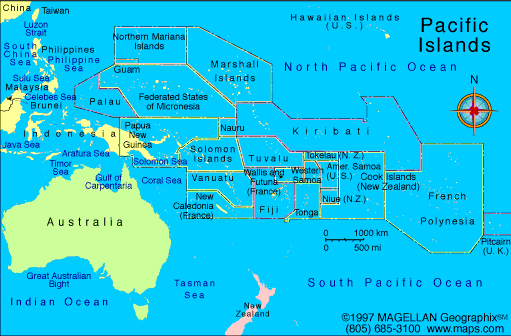
Map of Pacific Islands and Australia

Pacific Island nations have complex requirements for infrastructure.  It is tempting but foolish to see similarities and simply apply a one-size-fits-all.  

However, the best combination of infrastructure assets for Pacific Island nations will depend on the specific needs and resources of each individual nation. In general, however, there are a few key types of infrastructure that are important for the development and well-being of Pacific Island nations.

Transportation infrastructure: This includes roads, ports, airports, and other transportation networks that are necessary for the movement of people, goods, and services within the country and to other countries.

Energy infrastructure: This includes power plants, transmission and distribution networks, and other facilities that are necessary for the generation and distribution of electricity.

Telecommunications infrastructure: This includes networks of communication towers, cables, and other equipment that are necessary for providing telephone and internet services to the population.

Water and sanitation infrastructure: This includes systems for the treatment, distribution, and collection of water, as well as sewage treatment facilities and other infrastructure related to sanitation.

Health care infrastructure: This includes hospitals, clinics, and other facilities that are necessary for providing health care services to the population.

Educational infrastructure: This includes schools, universities, and other institutions that are necessary for providing education to the population.

It is important for Pacific Island nations to have a balanced and well-developed infrastructure system in order to support economic growth, improve living standards, and enhance the overall well-being of the population.  It means having an approach that enables strategic consideration and appraisal of a diverse combination of assets across a diverse set of countries.

Categories
Lytton Advisory

Supporting Queensland

Queensland unveils funding to connect employers with skilled workers -  Australian Manufacturing

Lytton Advisory is pleased to announce that the Queensland Government has extended our engagement for a further two years on:

Whole of Government Standing Offer Arrangement for the Provision of Professional Services (SOA reference number: QGP0050-18)

with approval to supply the following services:

Economics
(forecasting, modelling, revenue review, advanced analytics)

We look forward to working with colleagues in agencies across the Queensland Government service.

Categories
Lytton Advisory

Growing your business

Are you thinking of growing your business to the next level? 

Is your turnover between $2 million to $20 million a year? 

Contact us at Lytton Advisory for a no-obligation free consultation.

Categories
Lytton Advisory

Happy New Year!

Wishing clients, colleagues and friends a happy and prosperous 2022. Thank you to everyone who has worked with Lytton Advisory over the past year and has supported our efforts. We look forward to engaging with you all in the New Year.

Craig Lawrence, Managing Director

Categories
Lytton Advisory

Build Less Infrastructure, Make What We Have Better

Recently I was reading a LinkedIn post about infrastructure that was drenched in buzzwords.  It struck me that the big professional service fees are in new infrastructure and construction (building more). 

That is what many large advisory firms are seeing and want.  Fee incentives are all around the size of the overall spend.
However, I think a lot of the ‘thought leadership’ pieces from some of these firms skip over the maintenance and rehabilitation story (keeping what we’ve got going).

Those maintenance / rehab projects are more numerous and smaller in scale.  Also, they reach deep into local government systems, bypassing large state and federal bureaucracies.  

But there are no real fees for the large advisory firms in that.  

Neither federal nor state governments have been successful in keeping the lid on the costs of large projects – they seem to blow out.
And there do not appear to be any real consequences for poor advice.

It is an old line that infrastructure spending kick starts the economy.  Also the tired ’shovel ready’ cliche gets trotted out again and again.  More of the same thinking, really. Get ready for that to be turbocharged in the upcoming federal election.

We really need to get more service from the infrastructure asset dollar, rather than just building big, dumb assets.

It is instructive that recently a major firm fired a partner for telling its government client they were wasting taxpayer money.  That would never have seen the light of day without a transparent, independent inquiry process.

Some large firms are shamelessly conflicted with embedded contractors masquerading at senior levels as independent professionals when they are, in effect, overpaid departmental staff.

Are they being paid to steer projects or steer work to their firms?

Professionalism must be accompanied by independence and transparency, but the penchant for opinion shopping remains strong.

Quis custodiet ipsos custodes? (Juvenal)

Categories
Lytton Advisory

Two Paths

I have an enormous amount of respect for planners – infrastructure planners, economic planners, financial planners, city and town planners – anyone that has to marshal huge reams of data, distil the essence of need and come up with a future path for all of us.  Planning is one of the most difficult and contested activities around infrastructure.

Common to all planners is the need to look ahead and determine what investments are made when.  More importantly, planners are front and centre in determining why these investments occur in the first place.  Often, planners are actively shaping a ‘why’ that communities eventually embrace (or not).

It is often said that plans become obsolete upon first contact with reality.  In the sense that a plan is an abstraction of reality, this may well be true.

Recently I completed a short course in behavioural economics that really helps economists understand we live in a world of people, rather than stylised profit maximising agents.  And I am seeing how this affects the kinds of investments we make.  Toll roads that are hardly used, dams that we barely drink from, office towers that lie vacant.  It is sometimes difficult to reconcile perceptions of future use with the use that occurs.  It often feels no one is accountable for the herd of white elephants that choke off better investments.

I was reminded on a recent walk to remain humble and remember the whole point of public infrastructure is to serve the needs of the people.  Irrespective of drawing a seductive curve of path on a map, sometimes people simply want the utility of getting from point A to point B.  The challenge is knowing when function must dominate form.  My aesthete is always looking for that balance.